
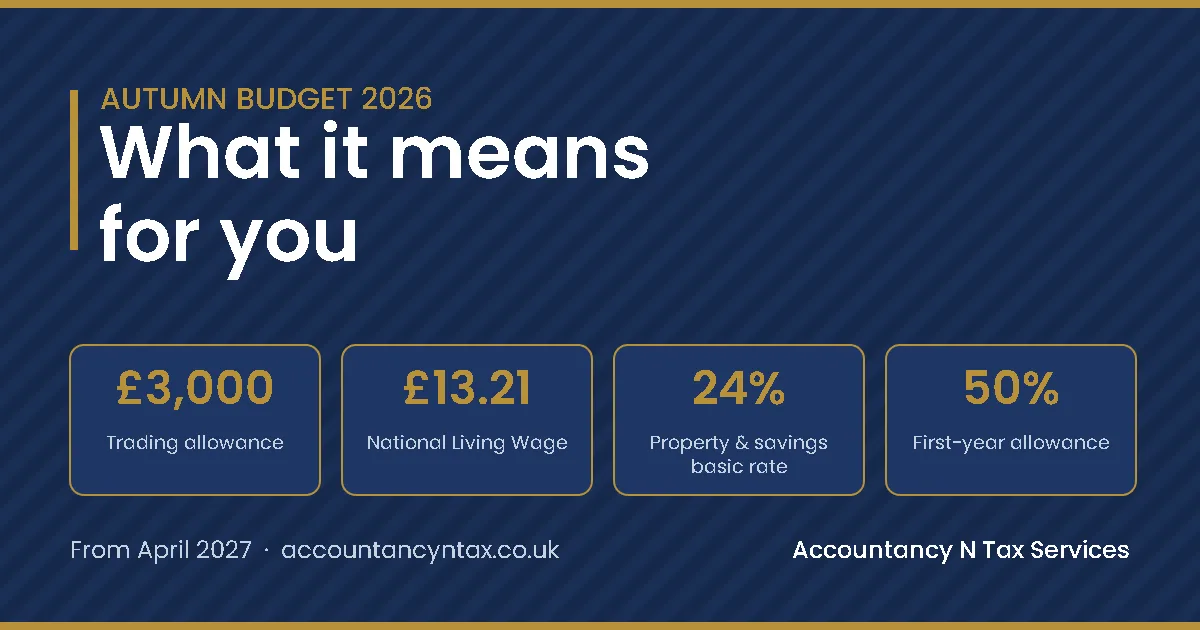
The Chancellor delivered the Autumn Budget on Wednesday 28 October 2026. There were no changes to the main Income Tax rates, the Personal Allowance or the VAT registration threshold, but there are several changes that matter for sole traders, landlords, employers and small company owners. Most of them start on 6 April 2027. Here is a plain-English summary from the team at Accountancy N Tax Services.
1. Trading allowance triples to £3,000
From the 2027/28 tax year (6 April 2027), the trading allowance rises from £1,000 to £3,000. The Self Assessment reporting threshold for trading income rises to £3,000 at the same time.
- If your gross income from self-employment or side work (for example selling goods online, odd jobs, tutoring or gig work) is £3,000 or less in a tax year, you will normally not need to report it.
- If your income is above £3,000, you can choose to deduct the £3,000 allowance instead of your actual expenses. Whichever gives the lower tax bill is usually best, and we can work that out for you.
- The allowance also covers certain miscellaneous income. Keep records of what you earn either way.
2. National Minimum Wage and National Living Wage rise by 3.9%
The new hourly rates apply from 1 April 2027:
| Rate | Current (from April 2026) | From April 2027 | Increase |
|---|---|---|---|
| National Living Wage (21 and over) | £12.71 | £13.21 | +50p |
| 18 to 20 year old rate | £10.85 | £11.27 | +42p |
| 16 to 17 year old rate | £8.00 | £8.31 | +31p |
| Apprentice rate | £8.00 | £8.31 | +31p |
| Accommodation offset (per day) | £11.10 | £11.53 | +43p |
For employers: update your payroll for the first pay period starting on or after 1 April 2027 and budget for the higher wage costs. Employer National Insurance stays at 15% above £96 a week, and the Employment Allowance stays at £10,500. If we run your payroll, we will apply the new rates for you.
3. Landlords and savers: higher Income Tax on property and savings income
From 6 April 2027, property income and savings income will be taxed at 24% (basic rate), 44% (higher rate) and 49% (additional rate). The property rates apply in England, Wales and Northern Ireland. Mortgage interest relief for landlords is also expected to be given at the new 24% basic property rate.
Interest earned inside an ISA stays tax-free, and the £20,000 cash ISA allowance is being kept, so the planned cut has been dropped. Landlords should review their structure and forecasts for 2027/28 now. Ask us if you would like a projection.
4. Capital allowances: bigger first-year allowance, lower writing-down allowance
- The main rate first-year allowance rises from 40% to 50% for qualifying new plant and machinery bought on or after 1 January 2027. Cars and second-hand assets are excluded.
- The main rate writing-down allowance falls from 14% to 12% from 1 April 2027 for companies and from 6 April 2027 for unincorporated businesses.
- Full expensing for companies and the £1 million Annual Investment Allowance are unchanged.
5. Business mileage: higher rate above 10,000 miles
The tax-free mileage rate for cars and vans stays at 55p per mile for the first 10,000 business miles. From 6 April 2027, the rate for miles above 10,000 rises from 25p to 35p.
6. Selling your business: Business Asset Disposal Relief limit halved
The lifetime limit for Business Asset Disposal Relief falls from £1 million to £500,000 for disposals on or after 6 April 2027. A new Founders’ Relief will give a lower Capital Gains Tax rate on qualifying disposals of shares from the same date, and the government is consulting on the details until 30 November 2026. If you are planning to sell or pass on your business, speak to us before April 2027.
7. Making Tax Digital and Self Assessment
- Sole traders and landlords who must join Making Tax Digital for Income Tax in April 2027 will not receive late submission penalty points for quarterly updates in 2027/28, which gives a soft-landing year.
- From April 2029, people who make Self Assessment payments on account will move to more regular, automated in-year payments, with an option to pay through PAYE.
8. Employers: payrolling benefits in kind
From 6 April 2027, company cars and vans, car and van fuel, and medical benefits must be reported through payroll instead of on P11D forms. Most other benefits follow from 6 April 2028.
9. Other headlines
- Small business rates (England): the 100% Small Business Rate Relief threshold rises from £12,000 to £18,000 rateable value. Pubs, social clubs and live music venues get 35% relief from April 2027.
- Fuel duty: the 5p per litre cut is extended to 1 July 2027.
- Energy: the 0% VAT rate on domestic electricity is extended to 1 July 2027, and a £100 Household Energy Payment goes to council tax band A to D households in England from January 2027.
- Pensioners: a new Pension Tax Allowance from April 2027 means people whose total income is no more than the full new State Pension will not pay Income Tax because of it.
What has not changed
- Personal Allowance stays at £12,570, and the basic rate band stays at £37,700.
- Main Income Tax rates stay at 20%, 40% and 45%. Dividend tax rates stay at 10.75%, 35.75% and 39.35%.
- Corporation Tax stays at 19% (small profits) and 25% (main rate).
- The VAT registration threshold stays at £90,000.
- Class 4 National Insurance stays at 6% and 2%, and Capital Gains Tax stays at 18% and 24%.
How we can help
Every business is different. If you would like to know exactly how the Budget affects you, whether you are a sole trader, landlord, employer or limited company director, our IFA-accredited financial accountants can review your position and plan ahead for April 2027.
Call 020 7112 9098, email info@accountancyntax.co.uk or book your free consultation.
This article is based on the Budget announcements and HMRC documents published on 28 October 2026. Some measures are still subject to legislation and may change. It is general information, not advice for your specific circumstances.
Sources: GOV.UK – Budget 2026; HMRC – Increasing the trading allowance; GOV.UK – Minimum wage rates for 2027; HMRC – Budget 2026 overview of tax legislation and rates.
Need help with this?
Speak to our IFA-accredited financial accountants in Wallington
Helping sole traders, landlords and small businesses across Sutton, Croydon and Carshalton. Fixed fees agreed before we start.
Get a Free QuoteCall 020 7112 9098